History of the place
From the king’s toll house to the metro
Lyngbyvej 1 stands at one of Copenhagen’s oldest meeting places. This is the story of the corner at Vibenshus Runddel – as far as we know it so far.
The king’s road
1580–1800-
1580s
A road for the king
Under Frederik II, a royal road is laid out from Copenhagen towards Frederiksborg. At first it is reserved for the king; during the 1600s it opens to ordinary traffic.
-
1629
The toll house
North of the Fælled common, a house is built for the gatekeeper who watches the traffic on the king’s road. Over time it becomes the inn Store Vibenshus – the beginning of the corner’s story as a place to stop. The inn was well enough known to appear in the writings of Søren Kierkegaard.
-
1649
The name Vibenshus
Until 1649 the house is home to Hans Andersen Vive, and it is from him that Vibenshus takes its name. The name appears in writing from 1669.
-
c. 1700
Lille Vibenshus
The inn gets a little sister, Lille Vibenshus, a little further east – roughly where Poul Henningsens Plads is today.
-
1764–76
The new royal road
The French road engineer Jean Marmillod builds a modern royal road from Vibenshus to Kongens Lyngby – with a firm surface, ditches and trees along both sides. It is the road we know today as Lyngbyvej.
-
1770s
The roundabout
The junction is laid out as a circle, and the place gets the name it still carries: Vibenshus Runddel.
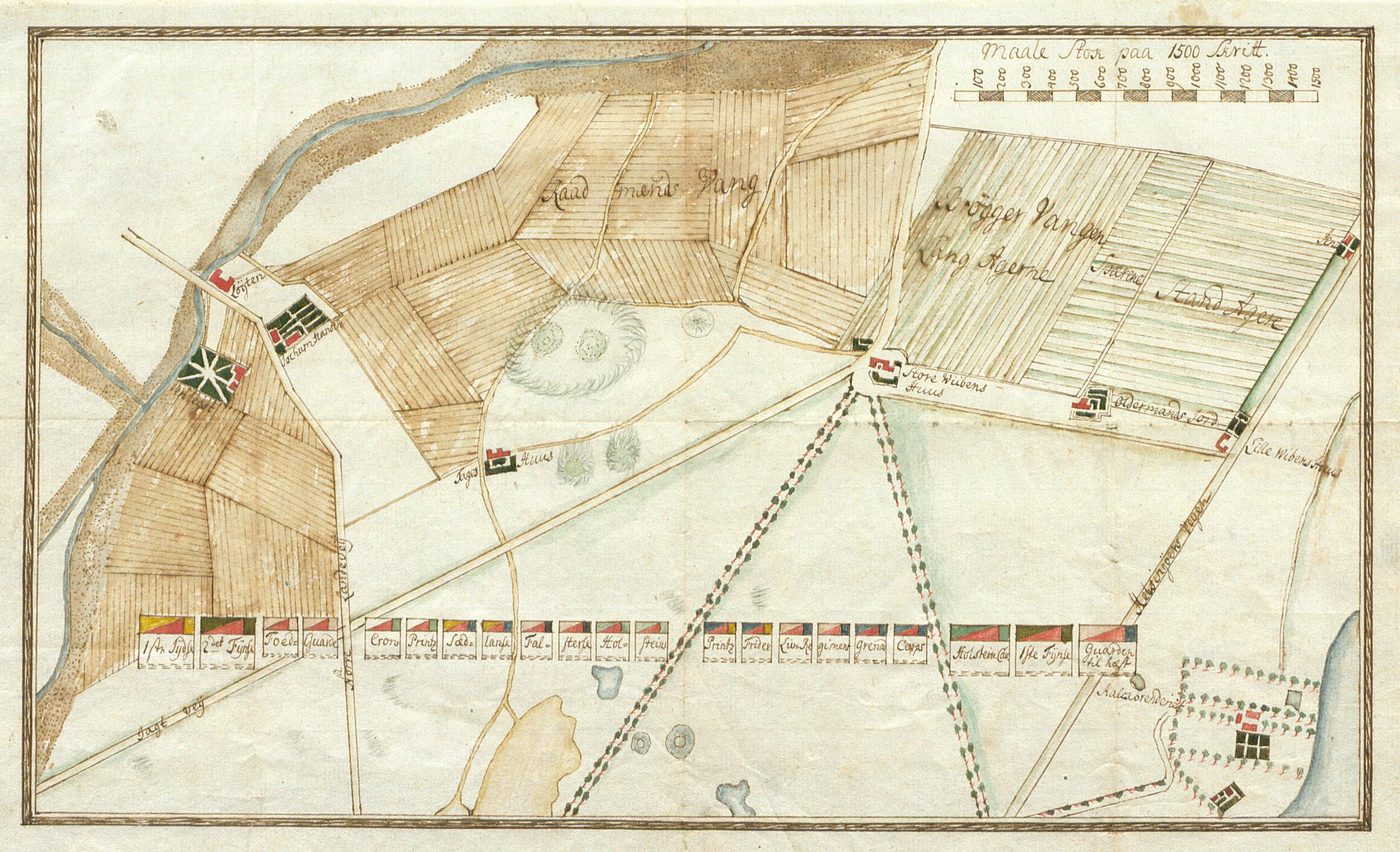
“Faneopstilling ved Jagtvej og Vibenshus” (a parade of flags), map from c. 1760.Royal Danish Library · Public domain

Inn, toll gate and chocolate
1800–1925-
1823
The toll gate at Vibenshus
Ole Jørgen Rawert paints the toll gate at Vibenshus on a June day in 1823. The watercolour shows a rural spot with tall trees and low houses – far outside the city ramparts.
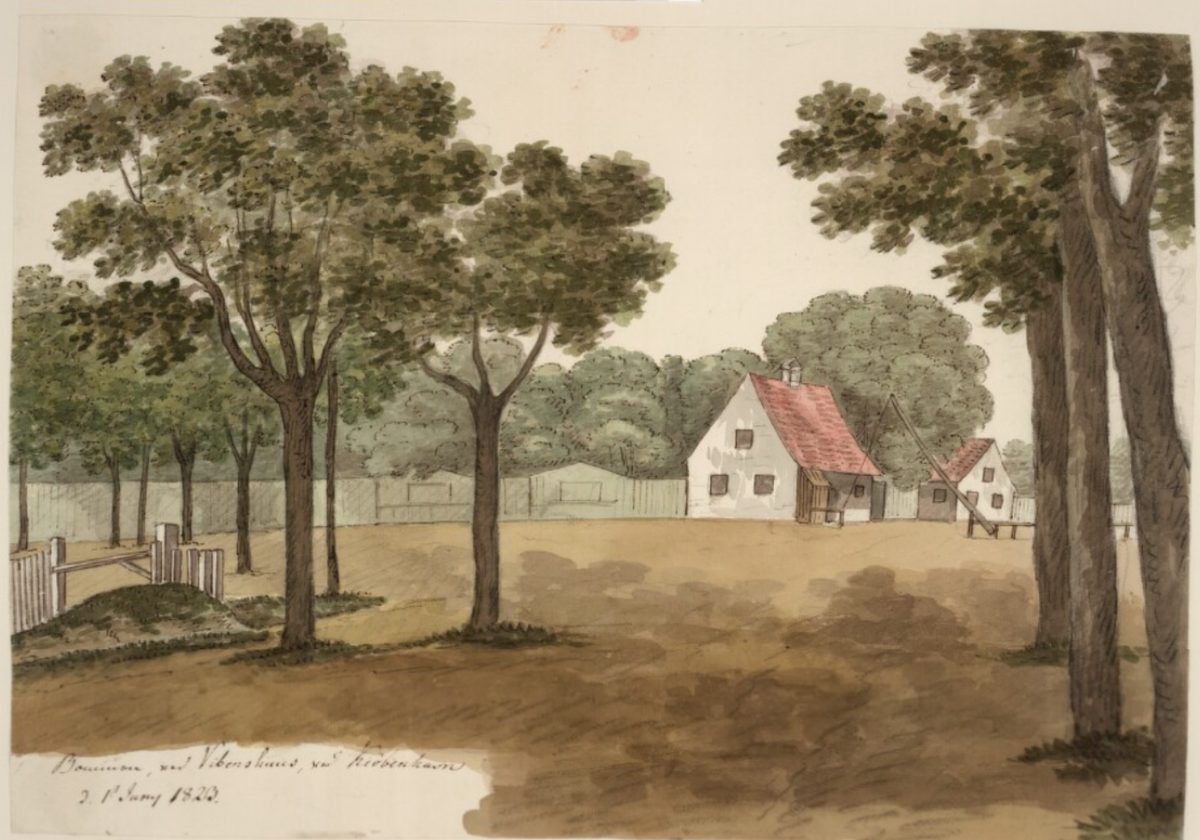
“Bommen ved Vibenshuus” (the toll gate at Vibenshus), 1 June 1823. Watercolour by O.J. Rawert.Royal Danish Library · Public domain -
1884
Chocolate arrives
The chocolate makers Galle & Jessen build a factory by the roundabout, across Lyngbyvej from us. It is extended several times and shapes the corner for more than a hundred years.
-
1906
Lyngbyvej 1 is built
Our corner building is completed: four storeys of red brick with a mansard roof and dormers facing the roundabout. The same year, Arbejdernes Byggeforening starts building the small terraced houses of the Lyngbyvej quarter right behind us, and work begins on turning the old common into Fælledparken.
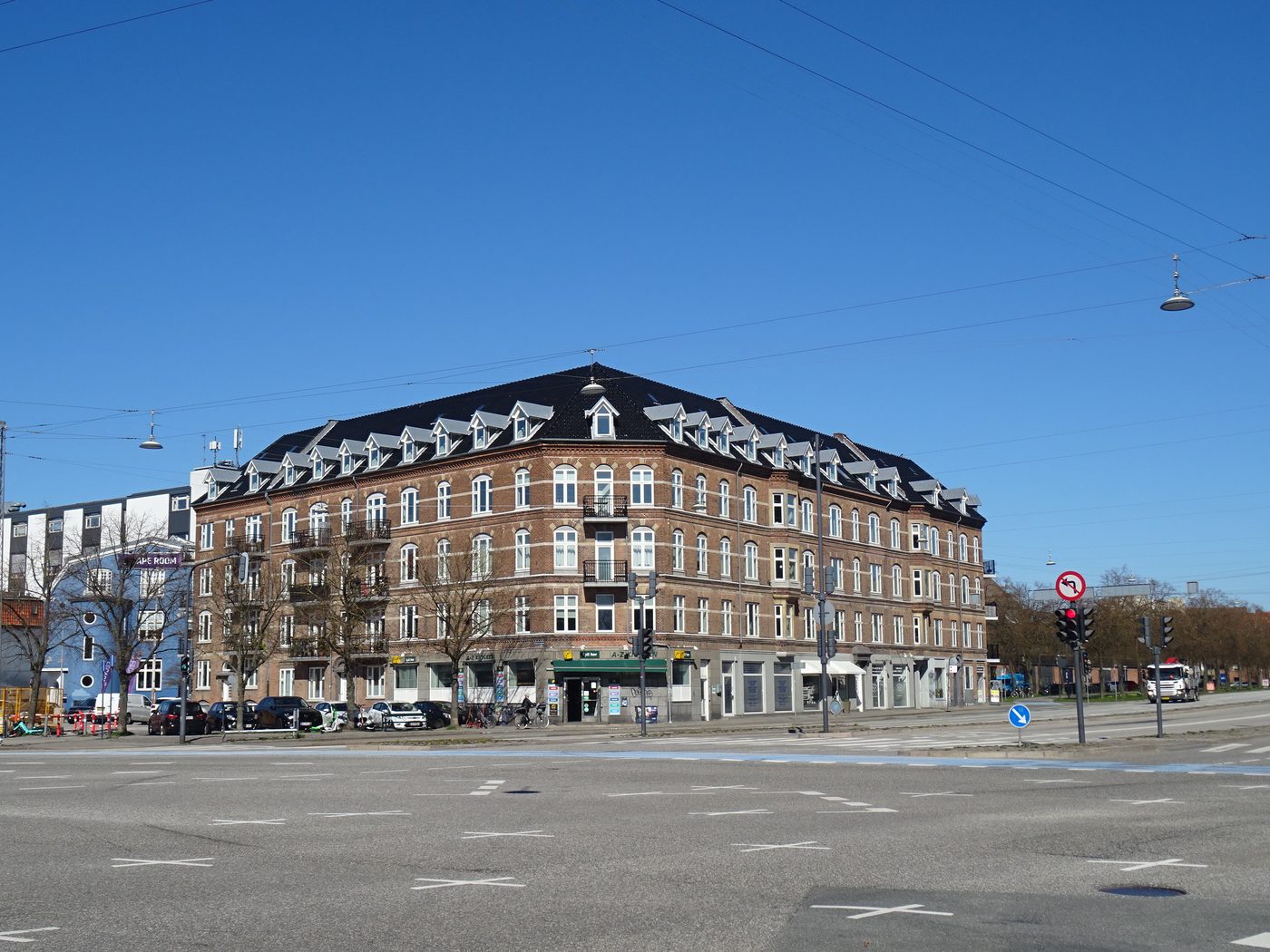
The corner of Lyngbyvej and Aldersrogade today.Photo: Leif Jørgensen, 2023 · CC BY-SA 4.0 · resized -
c. 1910
The inn by the roundabout
Store Vibenshus is photographed on the corner of Jagtvej and Lyngbyvej. Behind the bare trees rises a factory chimney – a sign that the city is growing out to meet the inn.
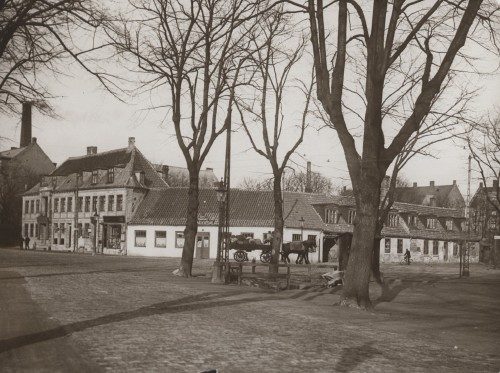
The inn Store Vibenshus, c. 1910.Museum of Copenhagen · Public domain -
1915
The tolls end
On 1 June 1915 the tolls on Lyngbyvej are abolished. From then on, everyone can travel the king’s old road for free.
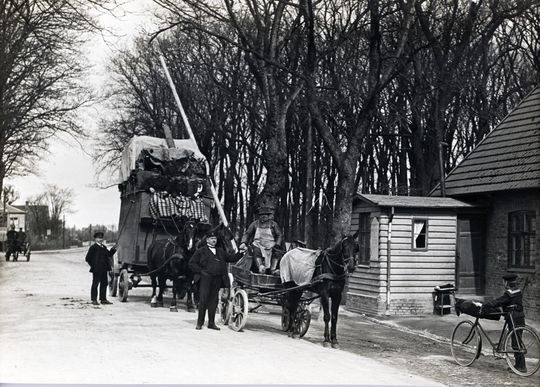
The toll house on Lyngbyvej by Emdrup Sø, 31 May 1915 – the day before the tolls were abolished.Museum of Copenhagen · Public domain -
1918
The building that was never built
An architectural competition is held for the factory corner. The young Kay Fisker wins with a large building with a curved façade, but it is never built.
-
1925
The inn burns
Almost 300 years after the toll house was built, Store Vibenshus burns down and is demolished.


The growing city
1925–2000-
19??
The bank on the ground floor
At some point in the 1900s a bank opens a branch on the ground floor – and the vault in the basement is still here. We are working on finding out which bank it was, and when it was here.
-
1932
The neon clock
Galle & Jessen put up a neon clock on the factory by the roundabout.
-
1965
The frogs start jumping
A neon sign with eight jumping chocolate frogs is mounted on the factory chimney. It becomes one of Østerbro’s best-loved landmarks.
-
1965–74
The great road widening
Lyngbyvej is widened as part of the Søring ring-road project. The cobblestones disappear, the middle of the road is lowered, and in the 1970s the roundabout itself is removed.
Today
2000–-
2000
Vibenshuset
The last factory buildings are replaced by the office building Vibenshuset, designed by C.F. Møller Architects with Anna Maria Indrio.
-
2009
Farewell to the frogs
In September 2009 the jumping chocolate frogs are taken down.
-
2019
The metro
On 29 September 2019 the City Circle Line opens, and Vibenshus Runddel gets its own metro station – right outside our door.
-
2026
Fælle Nord No. 1
A new chapter begins on the corner.
The basement
The bank vault
The basement beneath the shop holds the most surprising secret of the place: an old bank vault with thick walls and a heavy door. We would love to use the room – for tastings, special bottles or small events – but an old bank vault comes with strict requirements, and the approvals take time. For now, the vault is our storeroom.
We look forward to showing you pictures from down there.
Do you know the corner’s story?
If you have old photos, stories or memories of Lyngbyvej 1 – from the bank, the kiosk or the chocolate factory across the road – we would love to hear from you at info@faellenord.dk.
Sources
- Wikipedia: Vibenshus Runddel, Lyngbyvej (Danish), Lyngbyvejskvarteret (Danish) and Fælledparken.
- Søren Kierkegaards Skrifter, commentary on Store Vibenshus (Royal Danish Library).
- O.J. Rawert: “Bommen ved Vibenshuus”, 1823. Royal Danish Library, public domain.
- Map of Jagtvej and Vibenshus, c. 1760. Royal Danish Library, public domain.
- Store Vibenshus, c. 1910, and the toll house on Lyngbyvej, 31 May 1915. Museum of Copenhagen, public domain.
- Leif Jørgensen: “Aldersrogade – Lyngbyvej”, 2023. CC BY-SA 4.0.
- Year of construction for Lyngbyvej 1: the Danish Building and Housing Register (BBR).